

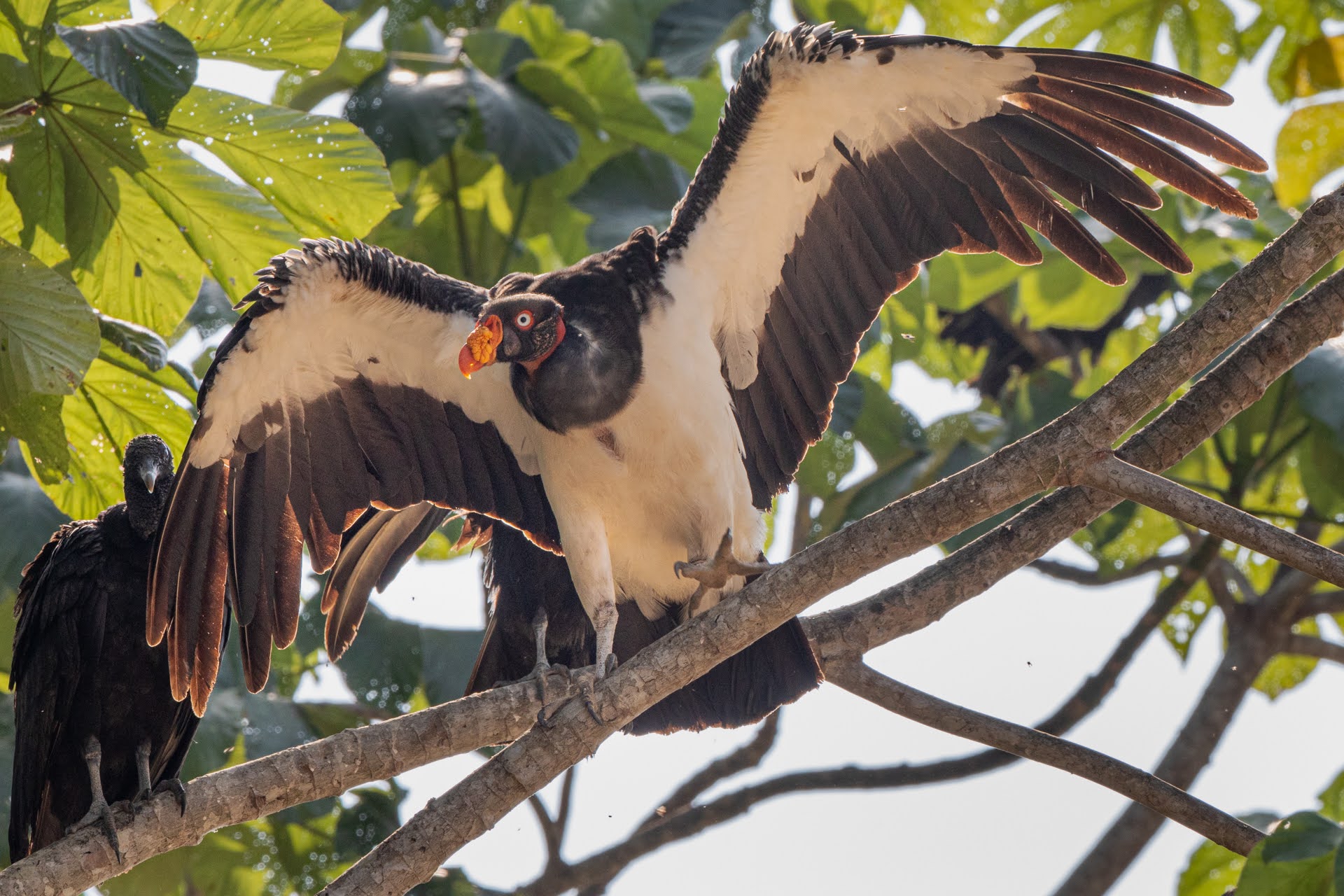
Conservación Osa’s Movement Ecology team is using innovative techniques to understand vulture behavior like no one else could before. This is what we know now.
Written by Giancarlo Velmarch.
Contributions by Enzo Basso and Diego Sancha.

How do you study a species that is so difficult to observe?
Deep within the forests of Costa Rica lives one of the region’s most elusive birds: the king vulture (Sarcoramphus papa). Despite being one of the largest birds in the area, seeing one is far from easy. Those lucky enough to encounter one often describe it as a flash of white crossing the sky before disappearing among the treetops.
Its rarity and elusive behavior led our research team to start asking questions. If we can only see it for a few moments, could we ever know what happens once it disappears into the dense forest? Very little is known about the places it uses to rest and feed, the routes it follows, or the way it moves through a landscape as vast and constantly changing as the Osa Peninsula. Behind every flight it takes and every carcass it finds lies a part of its life that remains beyond our view.
This is where one of the great challenges of studying a species like this begins. Occasional sightings are simply not enough to understand its daily life. We may find the animal, but that does not mean we can know what it does once it disappears among the treetops. To truly understand its behavior, we needed to find a way to follow its movements even when we could no longer see it.

Research: a key to conservation
Understanding and documenting vulture behavior is essential not only for science, but also for protecting the ecosystems in which they live. Their role in the forest is one of the least visible, yet one of the most important: decomposition. When an animal dies, a race against time begins. A carcass quickly becomes food for an entire community of organisms, and vultures play a key role in accelerating this process.
“Thanks to their presence, carcasses decompose approximately twice as fast, and the number of flies around them is reduced by half.”
— Julia Grootaers, field biologist, in a study conducted at Osa Conservation.
By consuming the tissues of dead animals, vultures help remove carcasses from the environment, allowing their nutrients to return to circulation and spread throughout the ecosystem. Without this process, decomposing flesh would trigger an ecological crisis, as it would be consumed slowly by bacteria and fungi, increasing the presence of dangerous pathogens that could spread freely through the soil and air and contaminate nearby freshwater sources.
This completely changes how we view vultures because their role is part of a much larger process that extends far beyond the animal itself.
For this reason, if we want to understand the role vultures play within the ecosystem, we first need to understand their behavior. We need to know where they search for food, which places they use to rest, how they move through the landscape, and what happens when they finally find what they were looking for. This is where the team faced its greatest challenge. To answer these questions, we first needed a way to observe every movement throughout their day, even when they disappeared from our sight.

What we already know
For decades, researchers around the world have used GPS trackers and accelerometers to study bird movements. These tools have made it possible to study parts of animals’ lives that were previously almost impossible to observe: where they are, which routes they follow, and how they move through the landscape.
GPS allows researchers to determine where a bird is and reconstruct its movements. However, to understand what the bird was actually doing in a particular place, researchers began combining GPS with accelerometers. These small sensors record how an animal’s body moves, allowing researchers to identify and record patterns associated with different behaviors, such as flying, flapping, resting, or even feeding. In this way, researchers can begin transforming a series of points on a map into information about an animal’s behavior.
The incorporation of these technologies has revealed, for example, that vultures do not use the landscape in the same way for all of their activities. As explained in our study published in 2025 by researcher Christopher Beirne and his colleagues of Conservación Osa. During the study, the researchers fitted satellite-tracking devices equipped with GPS, accelerometers, and altimeters to 43 vultures from three species: the black vulture (Coragyps atratus), the turkey vulture (Cathartes aura), and the king vulture (Sarcoramphus papa). The researchers used movement data to determine which habitats the birds selected depending on the activity they were performing: flying, feeding, or resting.
“We found that king vultures have a strong association with mature forests, particularly when flying or resting,” explains Beirne. “However, when feeding, some individuals also use grasslands associated with cattle-ranching areas, where they likely find an abundant food source in the form of livestock carcasses.”

The study also revealed that this relationship with agricultural areas was not the same for every individual. Some king vultures showed a greater tendency to use grasslands for feeding, while overall, the species maintained a strong dependence on large, continuous areas of mature forest. These results demonstrate the potential of combining three sensor types: GPS tells us where the animal is, the accelerometer helps us understand what type of movement it is making, and the altimeter provides information about the altitude at which it is moving.
But these tools also raise a new question: How can we be sure that we are correctly interpreting what the sensors are telling us?
A window into knowledge

Having all this information does not necessarily mean having all the answers. An accelerometer can detect that a king vulture’s body is moving in a particular way and that this pattern is repeated at different times. Based on these signals, an algorithm can classify a behavior as flying, resting, or feeding. But to know whether that interpretation is correct, we needed to verify it in the real world.
The problem is that directly observing a vulture is not always possible. A researcher can spend hours following an animal without ever seeing it feed, rest, or take off at the exact moment when the behavior occurs. And even though the sensors continue recording information throughout that time, we still need to know exactly what those signals mean.
The answer came when Enzo Basso, a conservation researcher at Osa Conservation, together with the Movement Ecology team and in collaboration with engineers from Wild Forest, integrated a new tool into the system: a camera capable of accompanying the vulture throughout its day. This represented a groundbreaking step for vulture research in the region, as it was the first time a system of this kind had been implemented on vultures in the Americas. By combining three complementary technologies in a single system |GPS, an accelerometer, and a video camera| we can obtain a much more complete picture of the bird’s behavior.
GPS allows us to know where the vulture is and reconstruct where it has traveled. The accelerometer records the movements of its body and allows us to identify patterns associated with behaviors such as flying, flapping, or feeding. The camera, meanwhile, allows us to directly observe what is happening in the vulture’s life at each recorded moment.

On the Osa Peninsula, this system was tested on three adult king vultures (Sarcoramphus papa). Our team fitted the three devices to the birds and, approximately one month later, thanks to their automatic release system, was able to recover them and analyze all the information recorded during that period. However, the camera was not there simply to obtain images. Its main purpose was to allow us to verify what the data recorded by the accelerometer actually meant.
While the accelerometer recorded the bird’s movements, the camera generated visual evidence of what was happening. This allowed researchers to compare the signals from the sensor with the behavior the vulture was actually performing in front of the camera. When the accelerometer identified a particular pattern as feeding or resting, the images allowed researchers to verify whether the bird was indeed feeding or resting at that moment.
This process is known as “ground truth,” or field validation: using direct observations to verify that interpretations obtained from data correspond to real behaviors.
This is where the combination of the three technologies truly comes together. The camera allows us to directly observe certain moments in the vulture’s life; the accelerometer records the movements associated with those moments; and GPS tells us where those behaviors took place. In this way, we can move from simply knowing where the vulture is to beginning to understand what it is doing there.

Understanding and conserving
This opens up a new dimension in research. If we can identify which accelerometer signals correspond to specific behaviors thanks to the images captured by the camera, we can use those patterns to interpret large amounts of data recorded during periods when we did not have direct observations, including our own previous research, such as Beirne’s study, adding a new level of clarity and allowing us to understand more precisely what the animal is doing in each of these places.
If we know which sites it uses to feed, where it rests, which routes it follows, and which environments are important for each of these behaviors, we can begin to identify the places that are especially important to the species.
This marks the beginning of a change in the way we look at the landscape, greatly advancing our understanding of the spaces this species needs and allowing us to focus our conservation efforts where they can have the greatest impact. Because protecting this species requires more than simply knowing it. It also means conserving the places it needs to survive.
Thanks to research like this, we can now begin investigating which of these sites are important on the Osa Peninsula. Which areas does it repeatedly use for feeding and resting? Which routes does it follow between different ecosystems? How important is it for the species to remain close to large areas of primary forest, or does it adapt well to open areas?
Our work does not end here. We still have much to discover. But we now have new tools with which to begin answering these questions and, above all, to transform that knowledge into conservation action.
Because protecting the vulture means much more than knowing where it lives. It means understanding which places it needs, what it uses them for, and how we can make sure those spaces continue to exist.

