

For years, we have installed and monitored canopy bridges. After analyzing the data, we discovered something that could change how we view wildlife crossings.
Written and photography by Giancarlo Velmarch
Contributions by Paulina Rodríguez, Johan Ortiz, and Diego Sancha
Click here to read the 2020–2025 Arboreal Bridges Report (Spanish version here)
The canopy: A lifeline of connectivity
If we were to travel through the forest the way arboreal species do, our feet would hardly ever touch the ground. We would leap from branch to branch, moving through a lush green landscape connected by trees stretching across hundreds of kilometers. Such is life in the canopy (the uppermost layer of the forest formed by treetops) in the Osa Peninsula, one of Mesoamerica’s most biodiverse tropical rainforests, where the connection between treetops is just as vital as the forest itself.
While many species walk or crawl along the forest floor, much of life unfolds meters above our heads. You only need to look up to watch the swaying branches and listen to the sounds filling the canopy. It is up there that monkeys, kinkajous, porcupines, opossums, tamanduas, and many other species find food, shelter, and a safe pathway to navigate without having to face the dangers on the ground.
For these animals, the branches form a network of natural highways that allow them to travel long distances in search of food, shelter, new territories, or even potential mates, thereby maintaining healthy ecosystems and populations.

When a road appears, the forest breaks
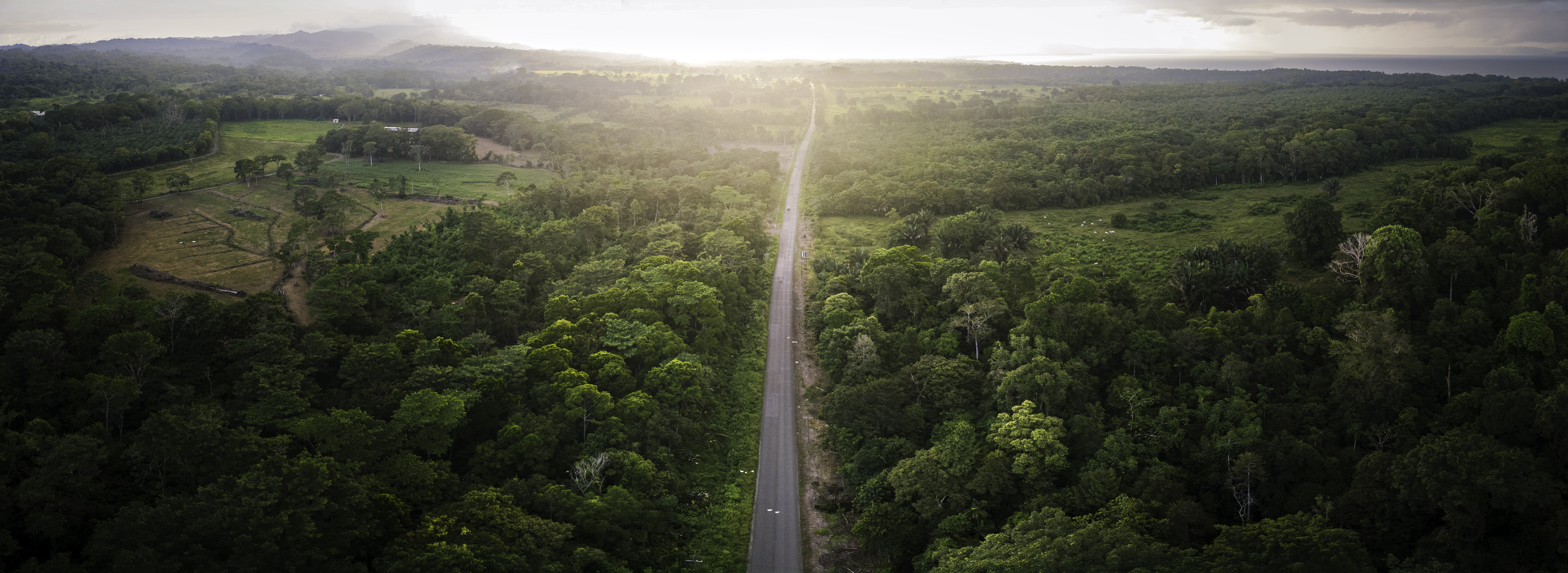
Although roads are essential for our travels, for an arboreal species, they represent quite the opposite. Even when seemingly harmless as they are just a few meters wide, roads sever treetops and fragment habitats, creating a barrier that many species cannot easily cross.
This issue occurs on roads all around the globe, but it is especially critical in the Osa Peninsula. Here, two main highways, the Pan-American Highway and National Route 245, run through the landscape between some of the region’s most important protected areas, such as Corcovado National Park, Piedras Blancas National Park, and La Amistad International Park. Although they do not run directly through the national parks, these roads cut through the forests that connect them, creating barriers that hinder wildlife movement between areas preserved for their protection.
When a monkey, a kinkajou, or a porcupine reaches the edge of a road, it faces a difficult decision. Some choose to descend to the ground to cross, exposing themselves to predators and vehicular traffic, where they risk being struck by cars. Others opt for a more familiar alternative, using power lines as if they were branches, which exposes them to the risk of electrocution. Still others simply stop crossing altogether, leading to the isolation of entire populations and reducing genetic diversity.
Despite seeming like the most logical option due to their abundance and proximity to the canopy, electrical cables pose a grave risk. As primatologist Andrés Martín explains in an interview with The Guardian: “To them, a power line is essentially a line of connected trees.” With no other choice available, their natural instincts lead them to use power lines to cross roads and deforested areas, with disastrous consequences. In just a single year, between June 2022 and June 2023, 6,262 wildlife electrocutions were recorded in Costa Rica, making it one of the leading causes of death for many arboreal species.

The question that started the project
What if we could reconnect the forest without moving a single tree?
For years, researchers and local communities watched as species that rarely set foot on the ground ended up as roadkill while attempting to cross highways. Every roadkill event and every electrocution was a clear sign that something was changing in the forest that once allowed these animals to roam with ease.
From these observations grew an urgent need to act. That was when Conservación Osa’s canopy bridge program was born. The goal was not only to reduce wildlife mortality, but to restore connectivity to one of Costa Rica’s most biodiverse landscapes. But before installing the first bridge, we set out to determine where they were truly needed.
This marked the beginning of a thorough identification process to locate sites whose ecological characteristics made them essential for forest connectivity and local species. Installing a bridge in the wrong place meant it might never be used at all.

Our team combined three key tools to understand how wildlife moves across the landscape:
The first tool was to use ground-level camera traps installed within the forest fragments on both sides of the roads. These cameras helped us determine which species were present, how frequently they utilized each sector, and where they were forced to descend to the ground to cross.

The second source of information was obtained by utilizing citizen science roadkill records, compiled through platforms like iNaturalist. This data allowed us to pinpoint specific collision hotspots where mitigation measures were urgently required.

Finally we utilized software like Circuitscape, a tool that enabled us to model wildlife movement and identify areas with the highest probability of use based on features like mature vegetation on both sides of the road.
By combining these three methodologies, we were able to select sites where canopy bridges had the highest likelihood of success. To be truly effective, every single installation needed to be backed by scientific evidence rather than mere guesswork or casual field observations.
Working in the canopy
Before ascending into the treetops, the work begins on the ground. Once the ideal locations are identified, one of the most demanding phases of the project starts. The team must haul all equipment to the installation site and prepare every single component: carrying ropes and tools that can weigh over 100 kilograms, mapping out access points for the selected trees, and coordinating every movement between the climbers and the ground crew.
On-site, two qualified tree climbers ascend tree by tree using specialized gear to set up the anchor points, while two other team members organize equipment and supervise the operation from below. Everything must be securely fastened, as the bridges need to withstand harsh weather conditions and constant animal traffic.
“Hauling ropes weighing between 120 and 160 kilos up to heights of 30 meters is no easy task. It requires a great deal of technical knowledge, dedication, and patience. At first, installing a single rope bridge took us up to five hours; over time, we streamlined the process, and for the last bridge we installed, it took us just under two hours. Still, it remains extremely demanding physical work.”
— Johan Ortiz, Wildlife Program Technician at Conservación Osa.

Throughout the project, we installed 35 canopy bridges that now reconnect forests once fragmented by roads and paths across the Osa Peninsula. We placed five distinct structural designs: mesh bridges, double-cable bridges, triple-cable bridges, double-parallel-cable bridges, and ladder-style bridges, each featuring unique characteristics tailored to the varied behaviors of canopy wildlife. Over time, we began to uncover which of these structures were used most frequently and why, marking one of the project’s first major findings.
Data revealed that double and triple cable bridges were used most frequently by a wider variety of species. Thanks to canopy-level camera traps, we observed that this was due to the natural behavior of species like white-faced capuchins (Cebus imitator) and kinkajous (Potos flavus), which use their prehensile tails to grasp one rope while walking along another—maintaining balance and crossing with greater agility. This insight allowed us to refine every new installation and tailor bridge designs to the specific species present in each area.
Once the installation was finished, the bridge stabilized between the treetops, and the final knot secured, the real work had only just begun.
Connecting trees is just the beginning
With the bridges in place, the observation phase began to see whether wildlife would recognize these new connections and integrate them into their routes. To find out, the team needed much more than a few occasional crossing records; it required monitoring each bridge day and night for years to understand how usage evolved over time. To accomplish this, we mounted camera traps on both ends of every canopy bridge installed across the Osa Peninsula. Over 1,705 monitoring days per bridge and a cumulative effort of 35,126 active camera-trap days, we quietly recorded every visit, every crossing attempt, and every species that approached to inspect these new structures.
Thanks to these images, we documented 6,122 individual crossings made by at least 15 different arboreal mammal species, including animals particularly vulnerable to vehicular collisions, such as the common opossum (Didelphis marsupialis) and the Mexican hairy dwarf porcupine (Coendou mexicanus).
However, the most significant discovery did not emerge until several months after installation. We initially expected that as animals incorporated the bridges into their daily routines over time, bridge usage would stabilize. Instead, the exact opposite happened.
Although the total number of species using the bridges did not increase substantially after 24 months, the frequency of crossings continued to rise exponentially over the 30 months following installation, showing no signs of slowing down. In other words, as time went on, individual animals increasingly integrated the canopy bridges into their daily movement routes through the forest canopy. This finding suggests that arboreal mammals require time to familiarize themselves with these artificial structures. Once they verify that the bridges are stable and safe, they begin using them with greater frequency, turning them into a routine part of their daily habitat.
“This is why long-term monitoring is so crucial to understanding the true effectiveness of a bridge. If we only monitor for three or six months, we might only see a couple of species cross and mistakenly assume the bridge isn’t working. But some species simply need more time.”
— Paulina Rodríguez, Wildlife Program Coordinator at Conservación Osa.
“Even four years after the bridges were installed, we observed additional species starting to use them. Iconic species like spider monkeys and sloths require much more time to explore, observe, and eventually trust the bridges before daring to cross,” Paulina adds.

Crossing the canopy
This project has delivered a clear lesson: reconnecting the forest is not something that happens overnight. Canopy bridges do not just need to be in the right location and feature the right design; they also need time for wildlife to recognize them, explore them, and ultimately adopt them into their travel routes. That is why our work does not end when a bridge is installed. In the coming years, our goal is to continue strengthening this connectivity network by identifying new locations where wildlife needs safe passage and maintaining the monitoring efforts that show us what works and how to improve.
Every new bridge represents an opportunity to give back to the forest a connection that human activity interrupted. But it is also an incredible opportunity for researchers and local communities to keep learning about the species that use them, the designs that work best, and how much time animals need to make these crossings part of their daily lives.
This work will soon become part of a new reality for wildlife conservation in Costa Rica. In August 2026, the Wildlife Infrastructure Passages Bill (Exp. 23.166) passed its second reading, legally mandating the inclusion of wildlife crossings whenever infrastructure projects disrupt natural connectivity and impede wildlife movement. This marks a major shift for the country, transforming wildlife crossings from isolated initiatives led by conservation organizations into an integral part of national infrastructure planning whenever studies deem them necessary.
It is precisely here that our work provides vital evidence on canopy bridge implementation, offering clear guidance on optimal structural designs and the timeframes required to maintain them on-site to preserve ecological connectivity and help wildlife find its path once again.

