

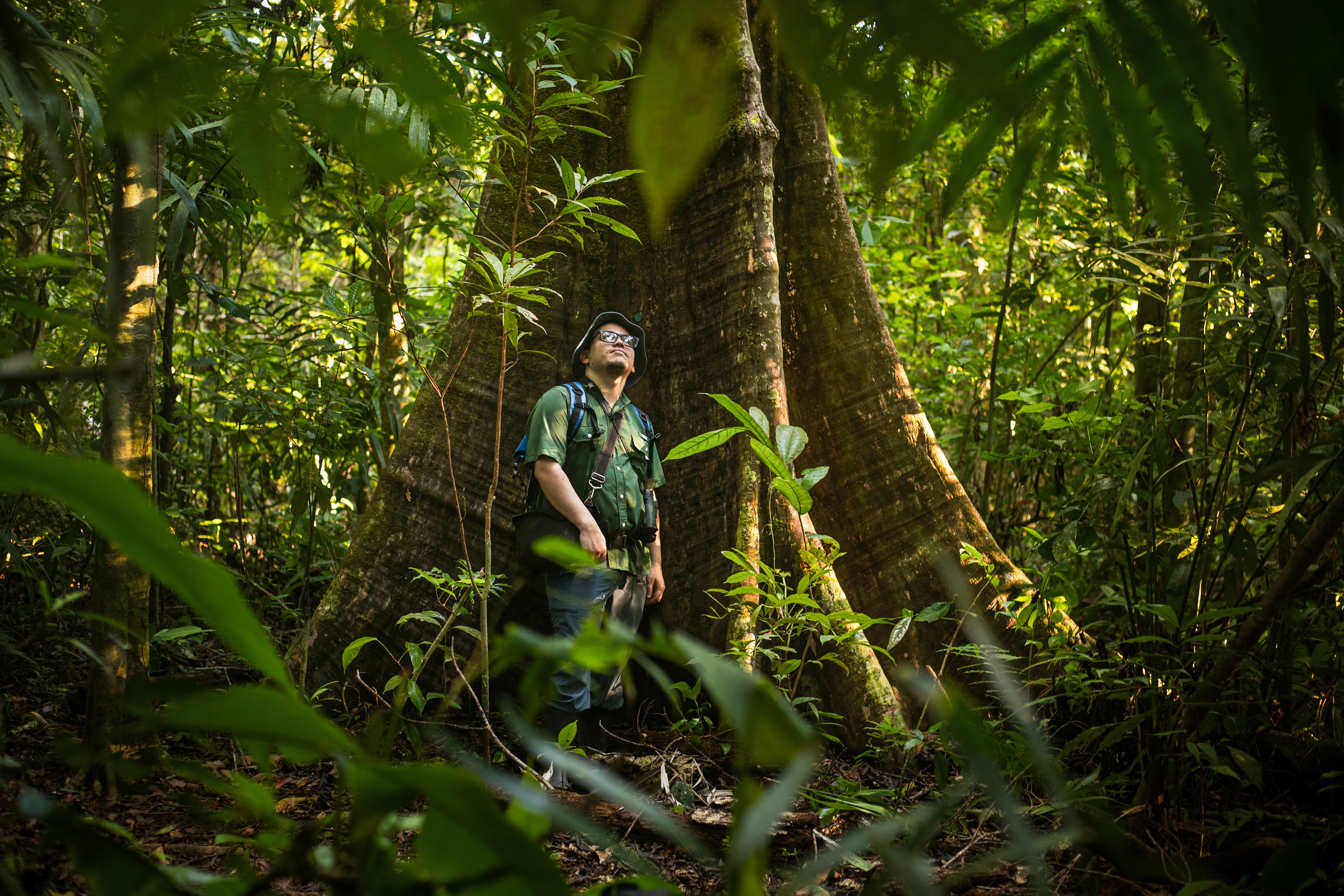
After years of expeditions and scientific research, the discovery of Labatia marvinlopezii shows us that the forests of the Osa Peninsula still hold secrets waiting to be uncovered.
The story behind a new discovery for Costa Rica’s biodiversity

We go back to 1990, when botanist Abelardo Chacón recorded the presence of a tree approximately 25 meters tall, very close to our biological station in Piro. To identify it, he collected several samples. However, it would take almost three decades for that tree, thanks to the persistence of one man, to once again capture the attention of experts.
Beginning in 2019, Marvin López Morales, a researcher in our botanical program, began observing the tree again and paying closer attention to its characteristics. His curiosity led him to show the specimen to an expert botanist, who identified it as Pouteria juruana, a species belonging to the Sapotaceae family.
This family of large trees represents a major challenge for botanical identification experts. If identifying and distinguishing different plant and tree species is already a considerable challenge, this particular family is even more complex because of the sheer number of species it contains. In Costa Rica alone, 69 species of Sapotaceae are known, and many share very similar morphological characteristics. Distinguishing between them therefore requires carefully examining small details that are usually found in the tree canopies, between 20 and 40 meters above the ground.
In 2021, the story of this tree took a new turn when Marvin’s curiosity and passion brought it back into the spotlight. Although it had already been identified, he showed it to Leonardo Álvarez-Alcázar, a botanist and consultant for Osa Conservation, who recognized that something was different about this specimen: its characteristics did not match what he expected to find in Pouteria juruana. A tree that had been seen from so many angles and examined by so many experts began raising questions, setting in motion an extensive scientific investigation.
“It was Marvin López Morales who brought this tree to our attention as botanists. From the moment he showed it to me, I noticed its larger leaves and the distinctive dark coloration on the forest floor. I almost immediately realized it was a different species. That was when the question arose: but which one?” commented Leonardo Álvarez-Alcázar, botanical consultant for Osa Conservation.

Following this observation, a process of description, comparison, and analysis began, eventually leading researchers to confirm that the tree was not Pouteria juruana, but rather a species that had never before been described by science: Labatia marvinlopezii.
Before the discovery
Although the discovery of Labatia marvinlopezii is an important finding, it represents only a small part of all the work behind it. This new species is an example of why we need to continue researching and learning about the trees that make up the forests of the Osa Peninsula and its surrounding areas.
Although this peninsula is just a small point on the map, it has an impressive topographic and ecosystem diversity that supports an extraordinary variety of species. In this corner of Costa Rica, we can find nearly half of all the country’s tree species, with approximately 800 species in total. Unfortunately, 150 of these fall into some category of threat, 56 of which are endemic to the peninsula. This means that a significant part of this diversity exists nowhere else in the world, and its conservation depends, to a great extent, on what we do now to protect its habitats and their connectivity.

We know that our forests are home to an enormous variety of trees, but many questions remain unanswered: Where do they grow? What is the status of their populations? What do they need to survive? Learning more about these species is precisely the first step toward understanding how to protect them.
The expeditions
With these questions in mind, between 2020 and 2024, with support from the Franklinia Foundation we launched a program focused on the research and monitoring of native trees. Our team focused particularly on 21 species classified as Near Threatened, Vulnerable, Endangered, or Critically Endangered. The project’s objective was to map their distribution, population status, and ecological requirements so we could understand where they grow, how many individuals exist, how they develop, and the conditions of the places they inhabit.

The project’s scope extended beyond the peninsula. Expeditions were organized from the Fila Costeña mountain range, at sea level, to the Coto Brus Valley and the foothills of the Talamanca mountain range, at elevations of up to 2,100 meters. This monitoring, carried out in areas not frequently visited by experts, allowed us to expand our knowledge of trees that often grow in remote locations or whose existence is known only to local communities. By collaborating with people living in these areas, we were able to strengthen our own conservation efforts while also raising awareness and creating economic opportunities on their properties.
The expeditions required months of preparation to decide where to go and how to reach those remote corners of the forest, often far from established roads and trails. Between December and May, taking advantage of the dry season, the team ventured into these areas on 12 expeditions lasting five to seven days each. On every journey, the botanists were accompanied by local guides with extensive knowledge of the terrain, field assistants, and climbers who helped collect samples from the tree canopies. In total, more than 30 people took part in this research, exploring different corners of the region and facing long hikes, challenging terrain, and nights camping in the middle of the forest.

Once the trees were located, the team recorded information about their location, the type of forest in which they grew, their size and developmental stage, as well as the presence of flowers or fruit. Every detail could reveal something new about the species. All this information was stored on their phones using a tool called Epicollect5, allowing it to be organized and compared later. But the work did not end when the team left the forest. They also returned to different locations to revisit previously recorded trees and observe how they were doing over time. All this work resulted in 1,550 botanical collections from 65 different locations, which can now be accessed and studied by researchers in various herbaria and specialized collections.

How do we know it is a new species?
Once the samples reached the herbaria, Leo began studying the Sapotaceae specimens collected in Osa more closely. By comparing them with other similar species, particularly Pouteria juruana and Labatia singularis, he began noticing differences that could not be explained as simple variations between trees of the same species. What had started as a suspicion in the middle of the forest was beginning to take shape: perhaps they were looking at a species that no one had ever described before.
To make sure, Leo joined forces with botanists Esteban Jiménez and Thomas Murphy. Together, the three examined samples collected in Osa and specimens preserved in herbaria across different countries. While Leo and Esteban studied the trees’ characteristics and compared their leaves, Thomas conducted statistical and digital analyses that helped confirm these differences. After months of work, this combination of approaches and three pairs of expert eyes provided evidence that they were dealing with a species never before identified by science.
And so, that large tree along the station’s trails, which had first caught Marvin’s curiosity, was eventually officially described as Labatia marvinlopezii, a new species to science whose description was published in November 2026 in the journal Systematic Botany.

“Its scientific name is a tribute to Marvin, who, through his curiosity, knowledge, and passion for the trees of the Osa Peninsula, has left an important mark on our forests and on science,” adds Leo.
What we still have to discover and protect
Finding a species and giving it a name is only the beginning. Thanks to this research, we now know that Labatia marvinlopezii has a fairly restricted distribution, occupying an area of just 28 km², and faces several threats, including illegal logging, uncontrolled understory pruning, and changes in land use, even within protected areas. For these reasons, we have preliminarily classified its conservation status as Vulnerable.

“Despite being a relatively well-known and previously explored area among several botanists, the Osa Peninsula still holds a certain degree of undiscovered diversity, particularly within the Sapotaceae family, which has historically received little attention compared to other plant groups in Costa Rica,” says Leo.

The story of Labatia marvinlopezii leaves us with three important lessons. The first is that behind a discovery there may be decades of observations, the work of many people, and an effort that continues long after the first specimen is found. The second is that expeditions and monitoring allow us to better understand the species that inhabit our forests, learn where their populations are found, and identify the threats they face. This information is essential for identifying the places that need greater attention, updating distribution maps, and guiding conservation actions, such as propagating native trees in our nurseries. And the third is that, despite everything we have learned, there are still species we know very little about and forests that hold stories we have yet to discover.
Every new discovery gives us another opportunity to understand the richness of our forests and find better ways to protect them, together with the communities that are part of these ecosystems and benefit from everything they provide. Because protecting our biodiversity also means dedicating time and effort to understanding it deeply. After all, how can we protect something we don’t even know exists?
